
Frequently Asked Questions
Quick answers to help you get started with confidence.
1. About UVB Phototherapy
What is NB-UVB phototherapy and how does it work?
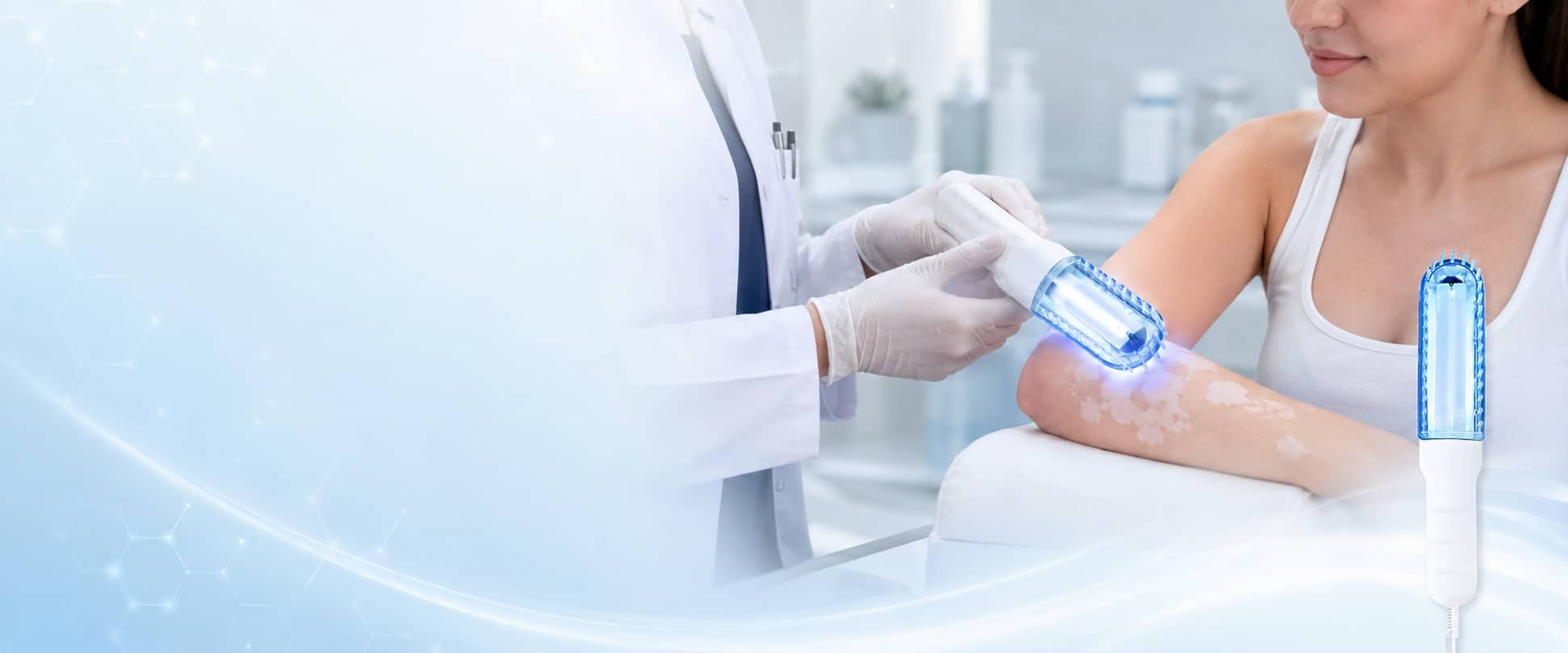
Narrowband UVB uses a concentrated UVB wavelength around 311–312nm. For psoriasis and eczema, it helps reduce excessive immune activity and skin inflammation; for psoriasis, it also helps slow the rapid buildup of skin cells. For vitiligo, NB-UVB can reduce the immune attack on melanocytes and stimulate remaining melanocytes—especially those around hair follicles—to multiply, migrate and produce pigment again.
What is the difference between 308nm and 311nm UVB?
Both are used for targeted UVB phototherapy, but the device design and coverage are different. YOUWEMED 311nm BU-series devices provide a 48cm² treatment area, making them practical for larger or multiple patches. YOUWEMED 308nm LED devices provide 2–22cm² coverage, allowing more precise treatment of smaller, clearly defined areas.
For a few small patches, a 308nm device is usually easier to position accurately. For larger or multiple areas, a 311nm device can cover the skin more efficiently.
How long does UVB phototherapy take to show results?
It depends on the condition and treatment area. With vitiligo, repigmentation usually develops gradually over months rather than days; clinical NB-UVB courses are often assessed after at least 12 weeks and may continue much longer. For inflammatory conditions such as psoriasis, some patients begin to improve after roughly 18–24 NB-UVB sessions, although individual responses vary considerably.
Why does vitiligo on the face usually respond faster than the hands and feet?
A major source of repigmentation is the melanocyte reservoir inside hair follicles. UVB can activate these pigment-cell precursors, which then migrate outward from the follicles into the white patch.
The face has a high density of hair follicles, providing more melanocyte reservoirs. Fingers, fingertips, palms, toes and other acral areas have fewer useful hair follicles and therefore fewer available pigment-cell reservoirs. This is one important reason facial vitiligo usually repigments more readily while hands and feet are often slower and more difficult to treat.
2. Treatment & Skin Response
How often should I use a UVB phototherapy device?
The schedule depends on the device and your skin response. YOUWEMED's current 311nm BU-series guidance uses treatment once every other day, about 3–4 sessions per week. Hospital NB-UVB schedules commonly use two or three sessions per week.
More frequent treatment is not automatically better. The skin needs time to show its response before the next exposure is adjusted.
What skin response should I expect after UVB treatment?
A mild, temporary pink or light-red response can occur after UVB treatment. The goal is controlled UVB exposure—not a strong sunburn.
Painful redness, strong burning, swelling or blistering means the exposure was too high and treatment should not be continued at the same dose.
How should I adjust the next session based on redness?
Use the previous skin response as your guide:
- No redness: increase only gradually according to the device instructions or treatment plan.
- Mild redness that has fully settled: the previous exposure may be maintained or increased cautiously.
- Redness still present before the next session: postpone treatment until the skin settles.
- Pain, swelling or blisters: stop treatment and allow the skin to recover completely; seek medical advice if the reaction is significant.
Do not make large jumps in exposure time or dose.
Does UVB treatment have to make the skin red to work?
No. Visible redness is not required for every effective session. Early exposures are deliberately kept conservative to test skin tolerance, so there may be little or no visible redness.
Do not keep increasing the exposure simply to “chase redness.” Treatment should be adjusted gradually according to skin response and the recommended schedule.
What if I have used UVB regularly but still see no improvement?
First check the basics: whether treatments have been regular, whether the correct skin area is being exposed consistently, whether the device is positioned as instructed, and—on lamp-based devices—whether the lamp has accumulated extensive operating hours.
If treatment has been consistent for an adequate period but there is still no clinical improvement, do not simply keep increasing the dose. The diagnosis, treatment plan, medications and treatment area should be reassessed with a dermatologist.
Can UVB devices be used on the scalp?
Yes, but hair can block part of the UVB light from reaching the skin. YOUWEMED 311nm devices include a detachable light comb that separates the hair and helps maintain positioning so more light reaches the scalp. 311nm devices
3. Safety
How should I protect my eyes and untreated skin?
Wear UV-protective goggles and never look directly at the operating UVB light source. Cover surrounding skin that does not need treatment with opaque clothing or fabric whenever practical.
Try to expose the same treatment area each session. Avoid applying sunscreen directly to the treatment area immediately before phototherapy unless specifically instructed, because it can change how much UVB reaches the skin.
What should I do if I get a strong burn or blisters?
Stop UVB treatment immediately. Do not expose the area again until the redness, pain, swelling or blistering has completely resolved.
If blistering is extensive, pain is significant, or the reaction does not improve, seek medical attention before restarting phototherapy.
Can medications or skincare products affect UVB treatment?
Yes. Some prescription medicines, over-the-counter medicines and herbal products can make the skin more sensitive to UV light. Perfumes, cosmetics and certain topical products can also change the skin's response.
Tell your healthcare professional about any medicines or topical treatments you use, especially when starting a new medication during a phototherapy course.
Can I continue UVB treatment in summer?
Yes, but total UV exposure matters. Natural sunlight adds additional UV exposure, so avoid excessive sunbathing and do not treat skin that is already sunburned.
On treatment days, keep unnecessary sunlight exposure to treated areas under control so that unexpected sun exposure does not add to the planned UVB dose.
Is long-term NB-UVB completely risk-free?
No UV exposure is completely risk-free. Excessive UVB can cause erythema and burns, while repeated cumulative UV exposure can contribute to premature skin ageing and may increase skin-cancer risk.
NB-UVB has a more favorable safety profile than some older phototherapy methods such as PUVA, but exposure should still be controlled and unnecessary UV exposure avoided.
4. Choosing a YOUWEMED Device
What is the difference between BU-1S, BU-1 and BU-10?
All three are 311nm NB-UVB devices with a 48cm² irradiation area and use a Philips PL-S 9W/01/2P UVB lamp. The main difference is control:
- BU-1S: one-button operation; simplest model.
- BU-1: adds a timer.
- BU-10: OLED display + physical buttons, with both Time and Dose control modes.
If you want simplicity, choose BU-1S. If you want easier time control, choose BU-1. If you want the most complete control interface, choose BU-10.
Which 308nm model should I choose?
Choose mainly according to the size of the area you need to cover:
- UV308A — 2cm²: smallest, precise areas
- UV308B — 4cm²: small areas with slightly wider coverage
- UV308E — 10cm²: medium areas and higher output
- UV308H4 — 16cm²: wider treatment area
- UV308V — 22cm²: largest coverage in the YOUWEMED 308nm range
A larger treatment window can shorten the time needed to cover multiple adjacent patches, while a smaller window makes it easier to avoid surrounding normal skin.
How long do the UVB lamp and 308nm LEDs last?
The Philips PL-S 9W/01/2P lamp used in the YOUWEMED 311nm series has an approximate service life of 800 hours. Replacement 311nm Philips UVB lamps are also available from YOUWEMED.
YOUWEMED 308nm LED devices are rated for 3,000+ hours of LED operating life.
Do I need to choose the correct voltage and plug?
Yes. YOUWEMED phototherapy devices are offered in different voltage and plug configurations. For example, BU-10 is available in 110V or 220V, with EU, UK and US plug options shown on the product page.
Choose the version that matches your country's power supply before ordering.
5. Shipping, Returns & Warranty
How long will my order take to arrive?
Orders are normally processed within 1–3 business days after payment confirmation. Standard shipping takes approximately 10 business days after dispatch, although customs clearance and local carrier delays may occasionally extend delivery time.
Once the order is shipped, you will receive a tracking number by email so you can follow the delivery status.
What are the return and lifetime warranty policies?
YOUWEMED accepts eligible return requests within 14 days after delivery. Products should be unused, undamaged and returned with the original packaging and accessories. For confirmed product-quality issues, YOUWEMED covers the return shipping cost; for non-quality returns, return shipping is paid by the customer.
YOUWEMED devices are backed by lifetime warranty support for eligible manufacturing and functional faults under normal use. Warranty does not cover misuse, accidental damage, unauthorized modification, normal wear or cosmetic damage.
For a damaged order, product fault or warranty request, contact support@youwemedcare.com with your order number and clear photos or video of the issue. YOUWEMED's warranty process already asks customers to provide this documentation so the problem can be diagnosed before repair or replacement is arranged.