

2 cm²
Focused target area
Designed for smaller localized areas where precise positioning matters more than broad coverage.


 Free Shipping · Duties & Taxes Covered
In stock

Compact, lightweight, and built for small-area, parent-assisted home routines with clear Time / Dose control.

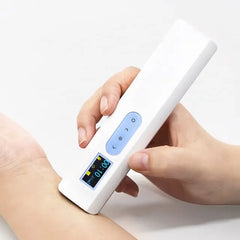
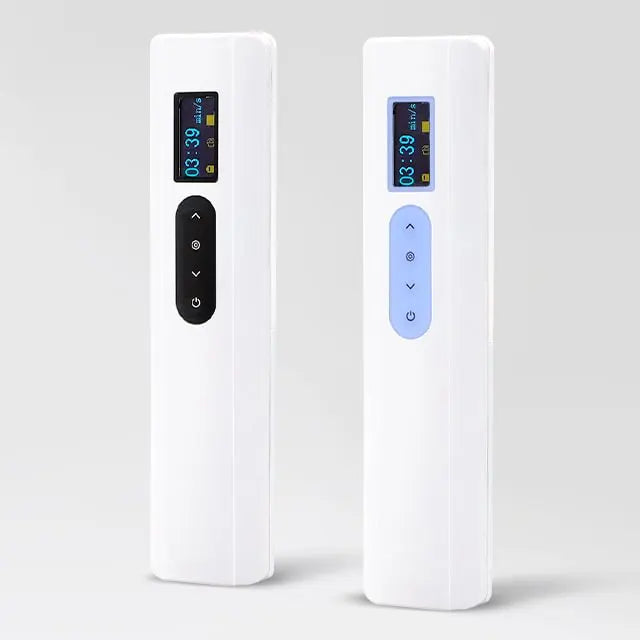
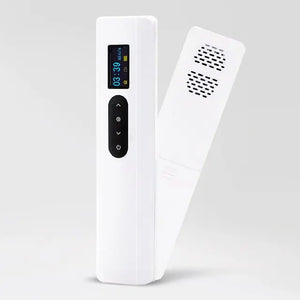
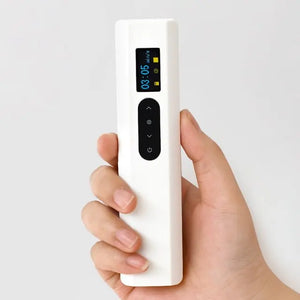
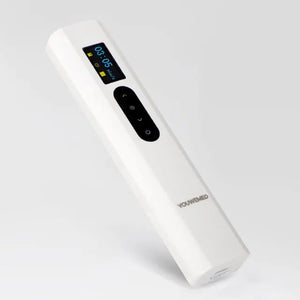
At about 70 g and only 36 mm wide, UV308A is easy to position over a focused 2 cm² target area.

Designed for smaller localized areas where precise positioning matters more than broad coverage.
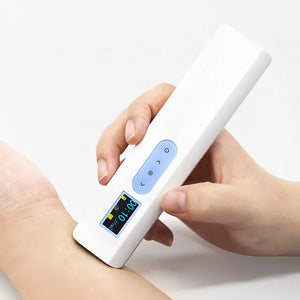
Easy for an adult to hold steadily and reposition during a supervised home routine.
Choose the control method that matches the selected treatment plan.
308nm LED technology with no routine lamp replacement.

Compact size, light weight and simple controls help parents manage a child’s supervised home routine.
An adult selects the setting, positions the device and manages the session.
About 70 g for steadier positioning over small treatment areas.
The OLED display keeps time and dose easy to check.
Short, localized sessions may be easier to manage when a child has trouble staying still.
All three share the same 2 cm² window, compact body, OLED display and Time / Dose modes. Output is the main difference.
6 LED chips
Lower-output option
6 LED chips
Mid-output option
8 LED chips
Higher-output option
For children, match the dose to the exact model—the same seconds deliver different doses on A1, A2 and A3.
For 308nm devices, the same number of seconds can deliver very different doses. Start from the selected dose, then convert it using the exact model’s irradiance.
1 mW/cm² × 1 second = 1 mJ/cm²
A German vitiligo guideline describes targeted 308nm starting doses of roughly 100–600 mJ/cm² depending on body site and MED. A published excimer review uses 150 mJ/cm² for face/neck, 200 for trunk/extremities and 300 for hands/feet, with a 50 mJ/cm² reduction suggested for pediatric use. [6][7]
These are literature references, not a validated universal UV308A prescription. Follow the UV308A IFU and clinician-selected dose.
| Reference site | Reference dose* | A1 · 20 mW/cm² | A2 · 35 mW/cm² | A3 · 50 mW/cm² |
|---|---|---|---|---|
| Face / neck | 100 mJ/cm² | 5.0 s | 2.9 s | 2.0 s |
| Trunk / arms / legs | 150 mJ/cm² | 7.5 s | 4.3 s | 3.0 s |
| Hands / feet | 250 mJ/cm² | 12.5 s | 7.1 s | 5.0 s |
*Pediatric-adjusted reference derived from a published excimer protocol. [7]
Use the selected protocol, body site and exact model.
Divide dose by the model’s irradiance.
An adult holds the device steadily and protects the eyes.
Check the skin before the next session; do not increase exposure while redness persists. [6][7]
Dose depends on the protocol, exact model and skin response. [1]
UV308A is the smallest targeted option. Compare it with broader-coverage 311nm and 308nm models below.
You’re viewing: UV308A · 308nm LED UVB · 2 cm² targeted area
| Product |
311nm NB-UVB

BU-1S
$179
|
311nm NB-UVB

BU-1
$199
|
311nm NB-UVB

BU-10
$279
|
308nm LED UVB

UV308B
$369
|
308nm LED UVB

UV308E
$469
|
308nm LED UVB

UV308H4
$399
|
308nm LED UVB

UV308V
$569
|
|---|---|---|---|---|---|---|---|
| Wavelength |
311nm
NB-UVB
|
311nm
NB-UVB
|
311nm
NB-UVB
|
308nm
LED UVB
|
308nm
LED UVB
|
308nm
LED UVB
|
308nm
LED UVB
|
| Light Source |
Philips PL-S
9W/01/2P
|
Philips PL-S
9W/01/2P
|
Philips PL-S
9W/01/2P
|
LED | LED | LED | LED |
| Light Area | 48 cm² |
48 cm² |
48 cm² |
4 cm² |
10 cm² |
16 cm² |
22 cm² |
| LED / Output | — | — | — | 8 LEDs | 20 / 30 LEDs | 33 LEDs | 40 LEDs |
| UV Intensity | — | — | — |
25–35
mW/cm²
|
40–60
mW/cm²
|
35
mW/cm²
|
40–50
mW/cm²
|
| Control |
One-button
Instant start
|
Button + Timer
Digital timer
|
OLED + Buttons
Time & Dose
|
Time & Dose
Display
|
Time & Dose
Display
|
OLED + Voice
Time & Dose
|
OLED
Time & Dose
|
| Weight | 0.48 kg | 1.28 kg | 1.25 kg | 0.12 kg | 0.30 kg | 0.56 kg | 0.44 kg |
| Easy Choice |
Simplest 311nm option |
311nm + built-in timer |
311nm + OLED control |
Compact + more coverage |
Higher output + medium area |
Wide area + light comb |
Largest 308nm coverage |
| Learn More | View BU-1S | View BU-1 | View BU-10 | View 308B | View 308E | View 308H4 | View 308V |
For children, an adult should manage the device and use the setting selected for the exact model.
Wear UV protective eyewear. Do not look into the light.
Do not copy another user’s dose or another model’s time.
Stop use if redness, pain or blistering persists.
Protect the treated area from unnecessary additional UV exposure.
Follow the UV308A IFU and professional guidance for treatment settings and safety.
UV308A is a small-area 308nm LED device with a 2 cm² light window. It is intended for localized phototherapy rather than broad body coverage. Your product documentation lists vitiligo and psoriasis use under professional guidance.
All three models use the same 2 cm² light window. The main difference is irradiance: A1 = 20, A2 = 35 and A3 = 50 mW/cm². Higher irradiance delivers the same dose in less time; it does not automatically mean a better result. Choose the model around the dose plan and tolerance, not simply the fastest exposure.
There is no universal first-time number of seconds. Targeted 308nm protocols usually start from a dose selected by body site, MED or professional guidance, then convert dose to time: time (s) = dose (mJ/cm²) ÷ irradiance (mW/cm²). For example, 100 mJ/cm² equals 5.0 s on A1, 2.9 s on A2 and 2.0 s on A3. [6][7]
Published 308nm protocols commonly use 2–3 non-consecutive sessions per week, with dose changes based on the previous skin response. Daily treatment should not be assumed unless it is specifically prescribed. [6]
Mild temporary pinkness can occur after UVB exposure. Pain, swelling, blistering, burning, or redness that persists beyond about 48 hours are signs to pause treatment and seek professional guidance before continuing. [6][7]
308nm phototherapy is usually judged over multiple sessions, not after one or two uses. Published 308nm LED studies evaluated response after 8, 16 or more sessions. Facial lesions generally respond better, while hands and feet tend to respond more slowly. [2][3][6]
Home-based 308nm LED has been studied in pediatric vitiligo, but children need closer supervision and careful dose selection. A 2025 study of 75 pediatric patients found home-based 308nm LED can be a viable option when cumulative dose is appropriately managed, while also highlighting the need for education and professional guidance. British guidance generally does not offer phototherapy to children under 5. [1][8]
They use the same target wavelength but different light-source technologies and delivery systems. Randomized studies in stable vitiligo have reported similar outcomes between 308nm LED and 308nm excimer lamp in selected protocols, but the devices and dosing schedules are not interchangeable. [2][4]
No. UV308A has much higher irradiance than typical 311nm handheld lamp systems, so its exposure time is usually much shorter. Do not copy a 311nm lamp schedule to UV308A; use dose-based conversion for the exact model.
No. Vitiligo and psoriasis protocols use different starting-dose logic and dose-adjustment rules. Published research supports targeted 308nm treatment in both conditions, but the treatment plan should match the diagnosis and body site. [5][6][10]
Published studies cited above evaluated other 308nm devices and clinical protocols. They do not constitute a clinical trial of UV308A and do not guarantee individual outcomes.